

 On the 5th Day of Christmas Past, Sheila Stephens (MHA Office Manager) shares a treasured Christmas memory followed by a pioneer account:
Question: What Christmas food delicacies are a special part of celebrating in these stories or for your family?
To be entered into today’s daily giveaway & FREE tour drawing- Read the story below; “Comment” & “Share” your answer on Facebook or our blog. Click Here for contest rules.
Mother’s Christmas Cake
Submitted by Sheila Stephens, MHA Office Manager
The year I was nine, my dad was a grad student working on a MS in mathematics at the University of Michigan. This would be the first year that we spent Christmas all on our own. Christmas was my mom’s favorite holiday so she was determined that it was going to be great. In spite of the fact that she really didn’t like cooking, she decided that we were going to have the beautiful Christmas cake she found in a magazine. The cake called for four layers, 4, 6, 8 and 10 inches. We didn’t have cake pans in four sizes, so she baked the layers in her skillet and sauce pans. This made for a LOT of cake, and since the pans were curved where the bottom and the sides met, our layers had round shoulders. The top layer of the cake was supposed to be cut into a star shape, so Dad got out his compass and protractor (math guy, right?) and made the pattern for the star. When it was all assembled, it was a really big cake, and not quite as beautiful as the picture. The round shoulders made the cake look slumped and we weren’t great decorators, but there it was, in all it’s glory.
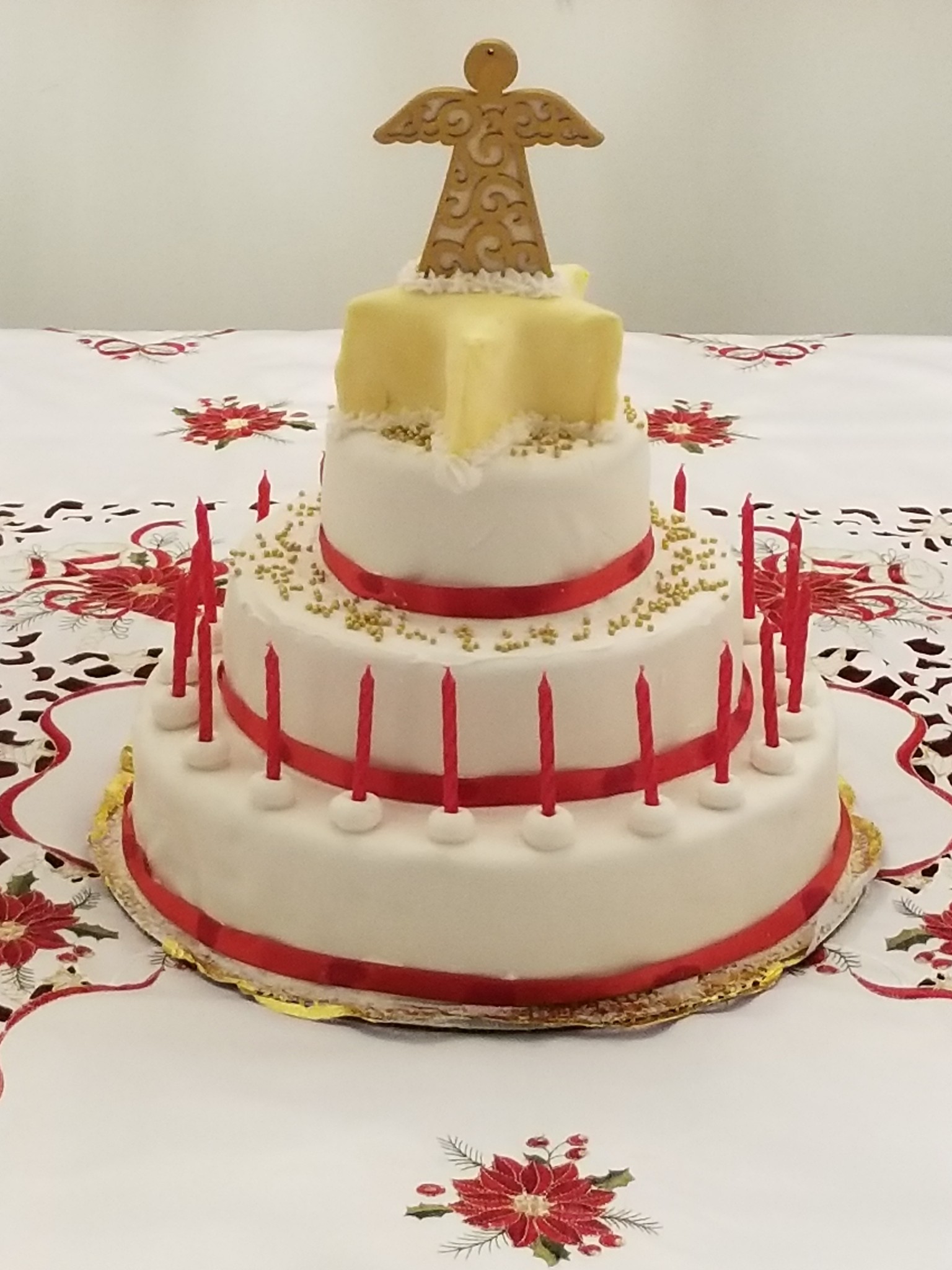 Spice cake (for the frankincense and myrrh), four layers to represent the 4000 years between Adam and Christ. The top layer was a star, for obvious reasons and the whole thing was frosted white for purity. Around the largest layer were 20 red candles, one for each century since Christ’s birth (it’s been a few years, of course), very carefully spaced out to be even by Dad, because you know, math. The red of the candles symbolized the blood of the atonement. The cake was sprinkled in gold dragees, for the gold of the Magi. The dragees looked like ball bearings, and were just about as tough to chew as real ball bearings would have been. On the top of the star layer was an angel.
We didn’t have much money to buy a tree, so the tree we got was three or four feet tall and we wrapped one of the end tables from the couch in a sheet and put the tree on top. We didn’t have any decorations for the tree either, so we bought a pound or so of salt water taffy and tied the taffy to the branches with red yarn. I remember being very proud of our little tree and our enormous round shouldered cake.
We made the cake every year for 10 or 15 years and then more sporadically after that. I don’t think any of us have made one since Mom died. (Although I think I still have a carton of gold dragees that I bought at an Amish store about 10 years ago, just in case.)
A Melting Pot of Pioneer Recipes
By Winnifred C. Jardine
Pioneer women who had to decide what few precious things to carry across the plains surely made one choice in common—their own individual collection of “receipts,” as recipes were then called. For them, these were reminders of a security left behind and a hope for the abundance of the future. In the interim, they simply did what they had to do to keep their families alive. Many early memories of pioneer food concerned the frugality with which the Saints lived: “We lived on cornbread and molasses for the first winter.” “We could not get enough flour for bread … so we could only make it into a thin gruel which we called killy.” “These times we had nothing to waste; we had to make things last as long as we could.” No doubt the “receipt” books were closed during these times, and efforts were given simply to finding food and making it go as far as possible. But slowly, even out of this deprivation, recipes grew. The pioneer women learned to use any small pieces of leftover meat and poultry with such vegetables as they might have on hand—carrots, potatoes, corn, turnips, onions—to make a pie smothered with Mormon gravy.
While the first few companies of pioneers were comprised mostly of New Englanders, other states were sparsely represented, as were Canada, England, Scotland, Wales, the Isle of Man, Scandinavia, Germany, and even Spain and Australia. Within the next five years thousands more from other European countries poured into Zion. And with them came their favorite national recipes enjoyed when able especially during special holidays. By the time other immigrants arrived, the critical food shortages were somewhat alleviated, with most families having access to milk and cream, butter and cheese, beef, lamb, pork, chicken, eggs, flour ground from their own wheat harvest, molasses and honey, and a little later, sugar.
Undoubtedly recipes passed from hand to hand. Truly, the cooking pot of the early pioneers was a melting pot for many kinds of cooking from many countries and ranged from the simplest and most humble of recipes to elaborate and elegant dishes from the kitchens of European kings. Early diaries are filled with happy reminiscences of work and fun: salt-rising bread mixed in mother’s “baking kettle” while traveling in the wagon, then baked over the campfire at night; bacon and sour-dough pancakes cooked over campfires; molasses taffy pulls made possible by generous dippings from the skimmings of molasses boilers; peach preserves cooked in the last of the molasses batch and stored in big barrels; fruits and vegetables dried for winter storage; buffalo pie and wild berries; raspberry and currant and gooseberry bushes planted near the house, yielding fruit quickly and easily.
So many people gathered together with their variety of foods. The years 1862 and 1863 saw thousands of Scandinavian Saints leaving their homeland to come to Zion. With them came some of their favorite recipes, including Norwegian fruit soup and Swedish jam cake. Of English origin, “currant whirligig” was made in pioneer times with native wild currants. It is equally good made with other tart berries, such as cranberries. Typically German, spiced red cabbage has been passed down as a favorite. It is still used in many homes today, traditionally in some as part of the Christmas feast. Currant bread was brought from Wales in 1856. The Welsh people often used it as a Christmas bread. The Saints found wild currants when they first arrived in the valley, and it is possible that they dried them for winter use. Raisins were not available until later, when cuttings for grapes were brought from California. Potato cake came across the plains with a young woman from Austria and are delicious served hot or cold with any kind of meat, fish, poultry, or salad. With the wild fruits—plums, cherries, grapes, gooseberries, currants—and the glorious fresh fruit cultivated so successfully from imported cuttings, the early pioneer women were soon making some of the delicacies that reminded them of “home.”
Taken from: https://www.churchofjesuschrist.org/study/ensign/1972/07/a-melting-pot-of-pioneer-recipes?lang=eng

Anise cookies from Germany.I would have loved to see that cake!
Sheila sent in a picture, now you can see it!
Yum, yum, yummy! Sampling foods from around the globe and sharing food with others is surely a way to bond and grow closer together as we sojourn on this earthly experience. It bridges the gap of differences and creates an atmosphere of plenty and thanksgiving. (think “Christmas oranges”, shared by segments)
Always German pancakes as my father,s side was from Germany. Memories of making them every year even to now. Tradition! We added home made marshmallow in the 1970’s and deliver to family’s with packets of hot chocolate to enjoy it in.
My family has a tradition of sugar cookies and rootbeer floats for Christmas eve. My mother-in-law was a wonderful cook and for many years we received a box full of cookies, cakes, candy and bread – we would say the Christmas arrived when her wonderful box did!
We have a tradition of making gingerbread houses. Baked extra long and using extra candies saved throughout the year. The best part comes on Christmas eve when we each get to smash our gingerbread house, followed by a beautiful evening about Christ. Out with the world and in with Christ.
The pioneers enjoyed their Spice cake & then with the migrations when food was more plentiful they enjoyed fruit soup, currant bread, jam cake, red cabbage, potato cake & many more. Our family always enjoys home made cinnamon rolls for Christmas breakfast. Many years for Christmas Eve we always did Fondue with meat & legs. Then Prime rib for Christmas dinner.
Traditions are very important. Food is especially traditional that we tie memories to. For Christmas we always had fruit cake. Many people don’t like it, but it brings back memories of home with my family when I was a small girl.
Food is such a big part of holiday festivities, and memories. In our family there is fruit salad, fudge and corn pop caramel corn at Christmas time. Sometimes it doesn’t turn out perfect, like times when we ended up with spoon fudge, but the memories are always there!
Love that food, especially traditional recipes are an important part of Christmas. Decorating home baked sugar cookies was always fun at our house.
Our family favorite is Clam Chowder on Christmas Eve. We also make Red Cabbage from my husband’s German family roots. My personal favorite are Gingerbread Cookies. Since my name is Ginger, we even had gingerbread men for our wedding reception!
My family’s traditional Christmas treats are English toffee and shortbread!
My children found a recipe in the Friend magazine for “Pineapple bacon wraps”, which we have made every year at Christmas for the past 30 years.
Making different kinds of Christmas cookies is always fun. Especially some tasty peanut butter kiss cookies. Our family also really enjoys sweet potato casserole, made with a brown sugar, pecan topping.
For Christmas dinner we have a big English style dinner, the best part comes the next day on boxing day where it all gets fred up together (potatoes, brussell sprouts, green beans, ham, turkey, and anything else savoury that is left over) its called bubble and squeak.
A melting pot of culture which is common with the founding of the United States was also common with those joining the church in Utah. The fruit, bread, and dessert dishes listed, along with the spice cake of the first of these stories makes me thankful for the cooks, the mothers and daughters of recipe holders, and the former servants of the nations of the world.
I remember tasting some of those specialties that came from some of those pioneer ancestors but we never built any traditions around them. When we started our family we have a few traditions that carried through. We had French Onion Soup for dinner. The kids loved the flavor but some of them didn’t like onions. No problem because I got extra onions in my soup. This was followed by frosted sugar cookies and homemade egg nog. To this day the grandkids walk in the door and ask if we are having grandma’s egg nog. I will make a double batch and if we are lucky my husband will have some to drink the next night by the fire.
Coming from a Pennsylvania Dutch/German culture, Sand Tart cookies decorated with Christmas sprinkles have always been my favorite holiday treat. The recipe, handed down from my great-grandmother, is equally enjoyed by newer and younger generations of my family. We look forward to baking and sharing them every Christmas!
We always have a French toast sausage casserole on Christmas morning. I make it the night before so it can set and just pop it in the oven in the morning. My kids expect it every year.
One of my favorite childhood memories is my mother’s family celebrating Christmas every December 23rd with dinner at my grandmother’s home. We always had a scrumptious dinner. My favorite favorite was dessert: Steamed Carrot Pudding topped with Lemon Sauce and whipped cream. Years later, my mom made carrot pudding, sadly it wasn’t very good, and that’s the last time I ate carrot pudding.
One other favorite Christmas treat is my mom’s delicious fruit cakes, two varieties. Mmmm!
Priceless memories!
What a wonderful Christmas tradition Sheila’s cake was and the love with which it was prepared as well as all it represented. Every year we cook prime rib for Christmas dinner. As a beef cattle ranching family that prime rib represents what we raise and sell and what supports us. We often invite extended family, neighbors, missionaries away from home to join in the feast.
Pretzel Jello Salad!! We don’t know the real name, so we gave it this descriptive-but-gross-sounding one for some reason. It is absolutely delicious and has been a family favorite since I was a kid!
Food, most especially holiday foods, not only bring back happy memories and bind us together as families across generations, but when we experience the foods of other cultures, this brings better understanding of and appreciation for those whose lives have been different from our own.
My five siblings and I always looked forward with eager anticipation to enjoying our mother’s special Christmas cookies, one shaped and colored like candy canes, another like small kaleidoscopes of three colors, and of course the peanut butter cookies with the Hershey’s kiss pressed into the center! My dad made a wonderful fudge every year from a recipe his mother had, and we would assemble plates of treats to take to neighbors during our family Christmas caroling on Christmas Eve. It was an unforgettable time for us all.